Napoleon’s Favourite Painter: The Rise and Fall of Andrea Appiani
Key Summary
Andrea Appiani rose to prominence by shaping the imperial image of Napoleon in Italy, using Neoclassical balance and symbolism to present power as legitimate, calm, and almost timeless.
His most important works—from royal portraits to monumental fresco cycles in Milan and Monza—combined political messaging with classical artistry, though many were later damaged or lost.
His career declined rapidly after Napoleon’s fall, showing how closely artistic success tied to power can vanish when the power behind it disappears.
In the age of empire, power was not sustained by armies alone—it was shaped through imagery. Few rulers understood this better than Napoleon Bonaparte, who relied on artists to construct his public identity across Europe. In Italy, that responsibility fell to Andrea Appiani, a master of Neoclassicism whose work blended political messaging with classical elegance.
Appiani’s career rose alongside Napoleon’s dominance and declined just as sharply after his fall. What makes his story compelling is not just the trajectory of his life, but the body of work—frescoes, portraits, and decorative cycles—that once defined imperial imagery in northern Italy. Shantala Palat, who is a renowned contemporary artist and painter in India, shares some insights in this blog.

How did Andrea Appiani become the visual architect of Napoleon’s rule in Italy?
Appiani’s ascent was rooted in his ability to translate political authority into classical visual language. By the time Napoleon established control over Italy, Appiani was already a respected decorative painter. His refined, balanced compositions made him an ideal candidate to craft the emperor’s image—not as a conqueror, but as a legitimate, almost timeless ruler.
This role became evident in his official portraits, such as Napoleon I as King of Italy (1805), with a major version now in the Kunsthistorisches Museum. In this work, Napoleon is presented in regal stillness, emphasising sovereignty rather than military aggression.
At the same time, Appiani was entrusted with monumental decorative programs. His “Apotheosis of Napoleon” (1808), created for the throne room of the Palazzo Reale di Milano, elevated the emperor into a near-divine figure. Though largely destroyed during World War II, surviving preparatory works—preserved in places like the Pinacoteca di Brera—reveal the scale and ambition of the project.
Contemporary artist Shantala Palat says, “Appiani did not just paint an emperor—he constructed an illusion of permanence, one that faded the moment history changed its course.”

The Great Decorative Cycles: Where Art Became Political Space
Appiani’s most powerful contributions were not isolated paintings but immersive environments. His fresco cycles transformed ceilings and walls into narratives of order, mythology, and imperial legitimacy.
Before his Napoleonic phase, he demonstrated this brilliance in the “Story of Psyche” frescoes (1789) at the Villa Reale di Monza. This cycle, filled with mythological grace and compositional harmony, established him as a leading decorative artist in Lombardy.
Later, at the Villa Reale di Milano, he created “The Parnassus” (1811)—a ceiling fresco depicting Apollo and the Muses. Though not overtly political, it reflects the same classical idealism that defined his imperial commissions, reinforcing cultural refinement under Napoleonic rule.

Sacred Foundations: The Church Commissions That Shaped Him
Long before Napoleon, Appiani built his reputation through religious art. Between 1791 and 1795, he decorated the dome and pendentives of Santa Maria presso San Celso with frescoes of the Evangelists and Doctors of the Church.
These works are essential to understanding his style. The clarity, balance, and controlled emotion seen here carried directly into his later political imagery. Even when painting an emperor, Appiani retained the composure of a religious painter.

Portraits of an Era: Beyond Napoleon
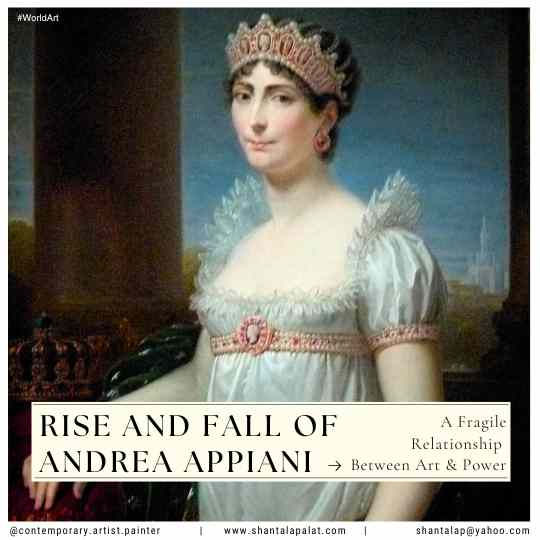
Appiani’s studio extended its influence beyond a single figure. He painted leading personalities of the Napoleonic world, including Joséphine de Beauharnais and Eugène de Beauharnais.
He also portrayed cultural figures like Ugo Foscolo and Antonio Canova, showing that his reach extended into intellectual and artistic circles. These portraits helped define the visual identity of an entire political and cultural elite.
The Fall: When Empire and Art Collapsed Together
Appiani’s success was inseparable from Napoleon’s power. When the empire declined, so did the system that sustained him. Commissions disappeared, political priorities shifted, and his major works—especially those tied to imperial propaganda—lost relevance or were actively neglected.
The destruction of key frescoes, particularly in Milan, further erased his presence from public memory. Unlike some contemporaries, Appiani did not reinvent himself in the post-Napoleonic world.

Final Years and Legacy
A stroke in his later years ended his artistic productivity, sealing his decline into obscurity. Yet his legacy survives in fragments—ceilings in Monza and Milan, portraits scattered across European collections, and preparatory works that hint at lost masterpieces.
Andrea Appiani’s story is not just about an artist—it is about the fragile relationship between art and power. He rose by shaping the image of an empire, and when that empire fell, much of his world vanished with it.


Comments