World’s Most Realistic Paintings: Astonishingly Lifelike Artworks
Painting is a form of inner expression. It is an honest reflection of thoughts and feelings, of moods and memories, translated into colour, texture, and movement. There are many different types of painting, each offering its own way of bringing the inner world onto a surface. Imagine how beautiful it would be to see a painting that looks absolutely real, like looking at yourself in the mirror.
Some styles lean toward realism, carefully observing the visible world and capturing it as faithfully as possible. Others move in the opposite direction. Abstract, impressionistic, or expressionist approaches focus less on what things look like and more on how they feel.
A memory may dissolve into loose brushstrokes, a mood might erupt in bold, clashing colours, or a quiet thought may settle into soft textures and muted tones. In today’s article, we explore the world’s most realistic paintings—astonishingly lifelike artworks that blur the line between art and reality through the eyes of renowned contemporary artist in India, Shantala Palat.
What is a Realistic Painting?
Realism in painting is an art style that shows the world as it truly is, without exaggeration or ideal beauty. It began in the 19th century as a reaction against dramatic and fantasy-based art. Realist painters focused on everyday people, real situations, and accurate details, helping art reflect real life and society more honestly. It focuses on careful detail, natural light, and everyday subjects, without adding fantasy or ideal beauty. From 19th-century Realism to modern hyperrealism, this style values close observation and often reflects real social life or ordinary moments just as they are.

Jean-François Millet’s The Gleaners (1857)
One of the most striking works of the Realist movement, Jean-François Millet’s The Gleaners (1857) portrays three peasant women gathering leftover wheat in an expansive rural field.
• Earthy tones and natural light emphasise physical hardship and restraint. • Bent figures and worn clothing reflect exhausting manual labour.
• The quiet mood conveys dignity rather than sentimentality.
• By focusing on gleaning, a task reserved for the poorest, the painting confronts poverty and social inequality, challenging artistic traditions that favoured elite, mythological, or religious subjects.

Eric Christensen’s Salute to Summer
Eric Christensen stands as a watercolour virtuoso, renowned for hyper-realistic wine still lifes that fuse delicate washes with the depth of wine culture. His luminous scenes capture vineyards, bottles, and glassware with warmth and precision, revealing subtle colour shifts and dancing light.
• Signature technique delivers vibrancy beyond photography
• Salute to Summer presents cherries, strawberries, brie, and a Bordeaux toast
• Celebrated Napa Valley artist, he narrates vineyards, wineries, and shared moments among friends and loved ones together warmly.
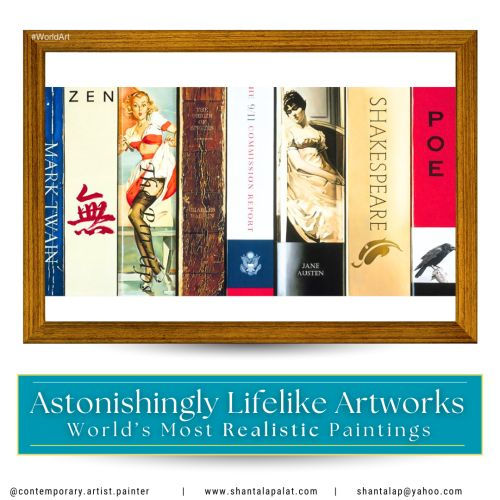
John-Mark Gleadow’s Bibliotheque series
His paintings are widely seen as realistic, even hyperrealistic, due to masterful oil-painting techniques that echo high-definition photography. His work is defined by:
• Immaculate surface detail, from glossy dust jackets to cracked leather spines
• Precise control of light, shadow, and depth
• Classical training that supports extreme accuracy. Paintings in the Bibliotheque series can take nearly two months to complete and often fool viewers into thinking they are photographs, while still pursuing visual truth beyond strict photorealism.

Leng Jun’s Hyperrealistic Portraits
Among hyperrealist painters, Chinese artist Leng Jun stands apart for oil portraits of women rendered with astonishing precision. His traditional process relies on painstaking layering and glazing • skin pores, fabric fibers, stray hairs, even the faint shadow of a single thread are visible. Focus is deliberately controlled, sharper than photography in places and softly blurred in others, creating emotional depth. Viewers lean closer, sometimes reaching for magnification, unsure whether they face paint or photograph with awe and quiet disbelief.

Gottfried Helnwein- American Prayer
He creates paintings so exact they are mistaken for high-resolution photographs until viewed inches away. His mastery of photographic technique erases visible brushwork, producing seamless tonal shifts that resemble developed film rather than applied pigment. This cool precision heightens the impact of his imagery. Executed in acrylic over digitally printed photographs, his figures are rendered with clinical restraint. In American Prayer, a kneeling child prays before an enormous, ominous Donald Duck, looming above him in a charged, unsettling tableau.
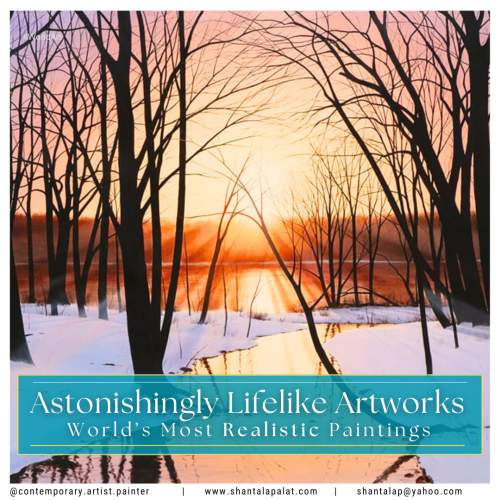
Alexander Volkov-Winter Tranquillity
Rooted in a lifelong fascination with light and shadow, Russian-American painter Alexander Volkov builds his work around their constant tension. Through dramatic illumination, subtle atmosphere, and exacting detail, he creates scenes that feel solid, immersive, and often nearly photographic. Using alla prima methods, fast-drying paints, and broad brushes, he achieves textured realism in landscapes drawn from the American countryside. Works like Winter Tranquillity feel convincing through nuanced color shifts, believable snow, and a quiet, reflective winter mood.
These are just a couple of examples showing how realism, from 19th-century social truth to contemporary hyperrealism, transforms paint into lived experience. Through meticulous observation, light, and craft, these artists honor ordinary lives, elevate everyday moments, and blur art and reality.


Comments